
For years, marketers leaned on data they didn’t own — third-party cookies, bought audience lists, behavioral signals borrowed from ad networks. That foundation is crumbling. Browsers block trackers, regulators tighten the rules, and people simply trust borrowed data less than they used to.
The answer most teams are landing on is first-party data: information you collect directly from your own audience, with their knowledge. It’s more durable, more accurate, and far easier to defend than anything you rent from someone else.
This guide explains what first-party data is, how it differs from the alternatives, and how to start collecting it responsibly. The goal isn’t to hoard more data — it’s to gather the right data in a way that respects the people behind it.
What Is First-Party Data?
First-party data is information you collect directly from your own audience, through your own properties. It comes from interactions people have with your website, app, emails, or support channels. Crucially, you own it, you control it, and you gathered it through a direct relationship.
Examples include the pages someone views on your site, the products they purchase, the forms they fill in, their email engagement, and the preferences they tell you outright. None of this depends on a third party tracking the person across the wider web.
First, Second, and Third-Party Data
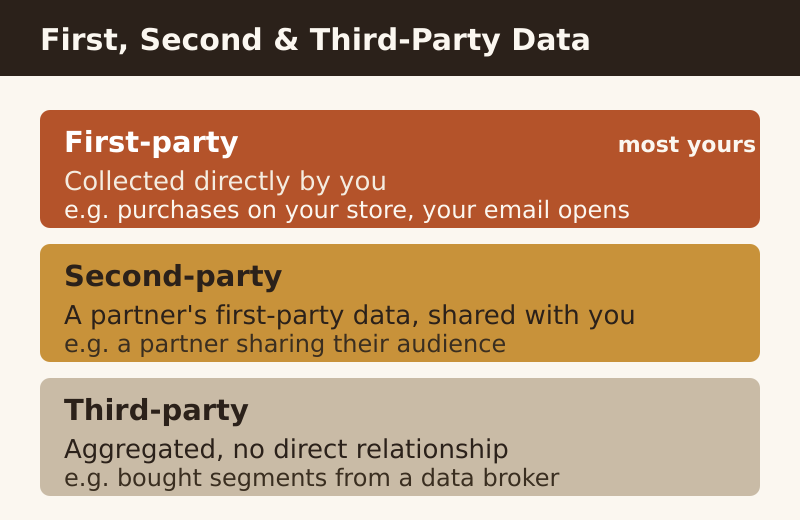
The terminology gets confusing, so let’s clear it up. The “party” refers to the relationship between you and the source of the data.
| Type | Source | Example |
|---|---|---|
| First-party | Collected directly by you | Purchases on your store, your email opens |
| Second-party | Another company’s first-party data, shared with you | A partner sharing their audience data |
| Third-party | Aggregated by a company with no direct relationship | Bought audience segments from a data broker |
First-party data sits at the top of this hierarchy for a reason. Because it comes from a direct relationship, it’s accurate, current, and yours to use within the terms people agreed to. Third-party data, by contrast, is often stale, loosely matched, and increasingly blocked by browsers and privacy laws.
Why First-Party Data Matters Now
The shift toward first-party data isn’t a passing trend. Several forces are pushing every team in the same direction.
- Browser restrictions: Major browsers block or limit third-party cookies, breaking the old cross-site tracking model.
- Privacy regulation: Laws like GDPR and similar frameworks demand a clear legal basis for collecting personal data.
- Accuracy: Data from a direct relationship beats inferred segments every time.
- Trust: People are more willing to share data with a brand they deal with directly than to be tracked invisibly.
Therefore, building a first-party foundation isn’t just defensive. It’s a competitive advantage. Teams that know their own audience well don’t flinch when the next tracking pipeline breaks.
How to Collect First-Party Data
Collecting first-party data well comes down to a simple exchange: you offer something useful, and people share information in return. Here are the most reliable channels.
1. Your Own Website Behavior
Every visit generates signals: which pages people read, what they search for, where they drop off. A well-structured tracking setup captures this without depending on third parties. The cleaner your implementation, the more trustworthy this data becomes. A solid data layer is the backbone here, because it gives you reliable, structured events instead of fragile guesses scraped from the page.
2. Forms and Sign-Ups
Newsletter sign-ups, account registrations, and gated resources let people volunteer information directly. The trade is explicit: they give you an email, you give them value. Keep these forms short. Every extra field lowers completion and rarely earns its keep.
3. Transactions and Accounts
Purchase history is some of the richest first-party data you can hold. It reflects real intent, not inferred interest. Account preferences, saved items, and order patterns all build a picture you can act on responsibly.
4. Surveys and Stated Preferences
Sometimes the simplest method is to ask. Preference centers, short surveys, and onboarding questions give you “zero-party” data — information people knowingly and deliberately hand over. It’s the most consent-friendly data of all, because the person is actively choosing to share it.
Collecting It Responsibly
Owning data directly doesn’t give you a free pass. The same privacy principles still apply, and frankly they should. Responsible collection protects both your audience and your business.
- Be transparent. Tell people what you collect and why, in plain language. A clear privacy notice beats a wall of legal text.
- Collect only what you’ll use. Data you never analyze is just liability sitting on a server. Minimize by default.
- Respect consent. Where the law requires it, get permission before setting non-essential cookies or processing personal data. Building a proper GDPR-compliant analytics setup makes this far easier to manage.
- Secure it. First-party data is valuable, which makes it a target. Treat storage and access controls seriously.
One more point worth stressing: privacy-respecting collection and good analytics aren’t in conflict. Many teams find that cleaner, consent-based data is also more useful, because it’s free of the noise and mismatches that plague borrowed third-party signals.
Common Mistakes
As teams pivot to first-party data, a few predictable errors show up. Watch for these.
- Collecting everything “just in case.” More data isn’t more insight. It’s more risk and more clutter.
- Treating it as a cookie replacement. First-party data is a different model, not a drop-in swap for ad-tracking cookies.
- Ignoring consent because “we own it.” Ownership and legal basis are separate things. You still need permission where the law says so.
- Leaving it siloed. Data trapped in five disconnected tools rarely produces a coherent picture of your audience.
Start small. Pick one or two high-value data points you’ll actually use — say, email engagement and on-site behavior — and build from there. A focused first-party foundation beats a sprawling one you can’t interpret.
Key Takeaways
A solid first-party data strategy is becoming the foundation of durable, privacy-respecting measurement. Remember the essentials:
- First-party data comes from a direct relationship with your audience — you own it and you control it.
- It’s more accurate and more durable than third-party data, which browsers and laws increasingly restrict.
- Collect it through website behavior, forms, transactions, and direct questions.
- Ownership doesn’t replace consent — transparency, minimization, and security still apply.
- Start focused: a few high-value data points you’ll genuinely use beat a vast, idle archive.
Ultimately, building a first-party data practice is about earning information rather than extracting it. Do that well, and you end up with measurement that’s both more reliable and easier to stand behind.