
Most analytics tools work the same way: you drop in a snippet, and your visitor data flows off to someone else’s servers. It’s convenient. It’s also a quiet handover of control. Your data lives somewhere you don’t own, under terms you didn’t write.
Self-hosted analytics flips that arrangement. You run the analytics software on infrastructure you control, and your visitor data never leaves your possession. For privacy-conscious teams, that’s an appealing proposition — but it comes with strings attached.
This guide explains what self-hosted analytics actually means, the genuine benefits, the real responsibilities, and how to decide whether it fits your situation. No product pitch — just a clear-eyed look at the model itself.
What Is Self-Hosted Analytics?
Self-hosted analytics means running analytics software on a server you control instead of using a hosted (cloud) service. You install the application, manage its database, and keep all the collected data on your own infrastructure. Nothing is shipped to a vendor’s platform by default.
Many privacy-focused analytics tools — particularly open-source ones — offer this option alongside a paid cloud version. The software is the same. What differs is where it runs and who holds the data. With self-hosting, the answer to both is: you.
Self-Hosted vs. Cloud Analytics
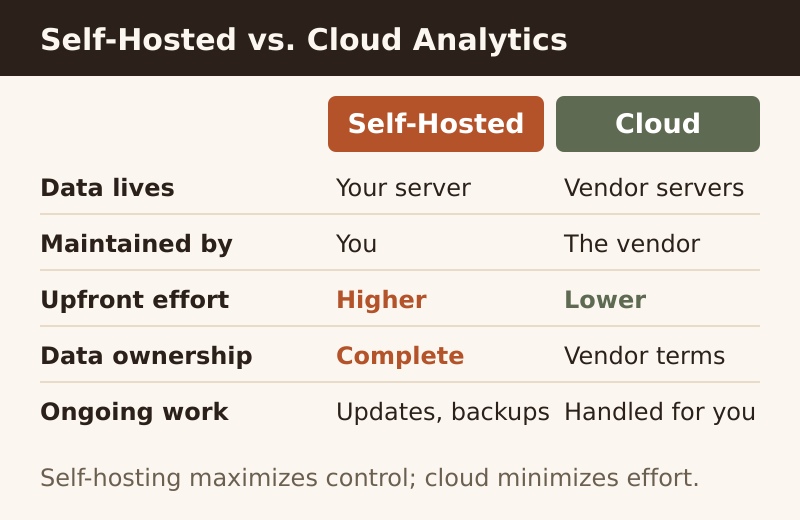
The distinction is easiest to see in a side-by-side comparison.
| Aspect | Self-hosted | Cloud (hosted) |
|---|---|---|
| Where data lives | Your own server | The vendor’s servers |
| Who maintains it | You | The vendor |
| Upfront effort | Higher (install, configure) | Lower (sign up and go) |
| Data ownership | Complete | Governed by vendor terms |
| Ongoing responsibility | Updates, backups, security | Handled for you |
Neither column is universally right. Self-hosting maximizes control at the cost of effort. Cloud minimizes effort at the cost of control. The best choice depends on which of those you value more — and which you’re equipped to handle.
Why Teams Choose Self-Hosting
People don’t self-host for fun. They do it because it solves specific problems that hosted tools can’t. Here are the most common reasons.
- Data ownership: Your visitor data stays on your servers, fully under your control, never passing through a third party.
- Privacy compliance: Keeping data in-house simplifies meeting strict regulatory or contractual requirements about where data may reside.
- No vendor lock-in: You’re not dependent on a provider’s pricing changes, feature decisions, or continued existence.
- Customization: With open-source tools especially, you can modify, extend, or integrate the software to fit your exact needs.
- Predictable cost at scale: Self-hosting can be cheaper for very high traffic, since you pay for infrastructure rather than per-event pricing.
For organizations that handle sensitive data or operate under tight data-residency rules, that first point alone can justify the whole approach. When the data physically never leaves your control, a large category of privacy concerns simply disappears.
The Responsibilities You Take On
Here’s the part that’s easy to underestimate. When you self-host, the work the vendor used to do becomes your job. That’s the real cost of control, and it’s ongoing.
- Installation and configuration: You need to set up the application, its database, and the surrounding environment correctly.
- Updates: Security patches and version upgrades are on you. Skip them, and you accumulate risk.
- Backups: If your server fails and you have no backup, your data is gone. Nobody else is keeping a copy.
- Security: A server collecting visitor data is a target. Hardening, monitoring, and access control fall to you.
- Scaling: As traffic grows, you have to ensure the server keeps up rather than buckling under load.
Self-hosting doesn’t remove the work of running analytics. It transfers that work to you. The question isn’t whether the work exists — it’s whether you’re prepared to own it.
None of this is insurmountable. Plenty of small teams self-host successfully. But it’s honest work, and pretending otherwise leads to neglected servers and lost data. Going in with eyes open is half the battle.
Who Should Consider It
Self-hosting suits some teams beautifully and frustrates others. Here’s a rough guide to which camp you’re in.
Good Fit
- Teams with technical capacity to maintain a server reliably over time.
- Organizations with strict data-residency or privacy requirements.
- High-traffic sites where per-event cloud pricing becomes expensive.
- Anyone who wants full ownership and is willing to do the work for it.
Probably Not Worth It
- Small teams without anyone to maintain infrastructure.
- Projects where a privacy-friendly hosted tool already meets your needs.
- Anyone who’d rather spend time analyzing data than administering servers.
For many sites, a hosted privacy-first tool delivers most of the benefit with none of the maintenance. Several modern analytics platforms collect minimal data and avoid invasive cookies entirely, which addresses the core privacy concern without you ever touching a server. If you’re weighing your options, it’s worth comparing those cookieless analytics alternatives before committing to self-hosting.
How to Decide
Run through these questions honestly before you choose.
- Do you have someone to maintain it? If nobody owns updates, backups, and security, self-hosting will fail quietly.
- Do you have a real data-control requirement? If a hosted privacy tool meets your obligations, the extra effort buys you little.
- What’s your traffic scale? At very high volumes, self-hosting can save money. At low volumes, it rarely pays off.
- What’s your tolerance for downtime? When the server is yours, recovery is also yours.
If you answered “yes, and we’re ready” to the maintenance and control questions, self-hosting is a strong, principled choice. If you hesitated, that hesitation is useful information — a hosted privacy-first tool is likely the saner path.
Key Takeaways
Self-hosted analytics trades convenience for control. Whether that trade is worth it depends entirely on your team and your needs:
- Self-hosting means running analytics software on infrastructure you own, keeping all data in-house.
- The benefits are data ownership, privacy compliance, no vendor lock-in, and customization.
- The responsibilities — installation, updates, backups, security, and scaling — all become yours.
- It suits technical teams with real data-control needs or high traffic.
- For many sites, a hosted privacy-first tool delivers most of the benefit with far less effort.
Ultimately, choosing self-hosted analytics is choosing ownership and responsibility together — you can’t take one without the other. Decide based on what you genuinely need and what you’re equipped to maintain, not on which option sounds more principled.