
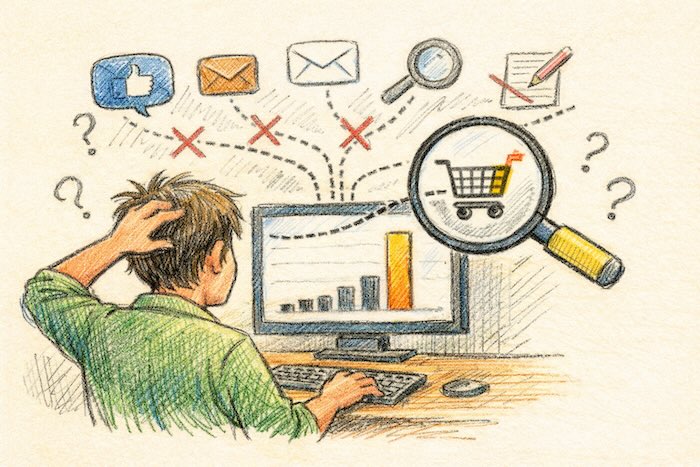
Your marketing reports say Facebook ads drive 65% of conversions. So you double down on Facebook and cut everything else. A month later, sales drop by 60%. What happened?
You just learned the hard way why last click attribution is one of the most dangerous defaults in marketing analytics. It told you a simple story that felt true but was actually misleading you into killing the very channels that fed your funnel.
This guide will show you exactly how last click attribution distorts your data, when it actually makes sense to use it, and what to do instead. By the end, you’ll know how to spot attribution problems in your own reports and make smarter budget decisions.
What Is Last Click Attribution?
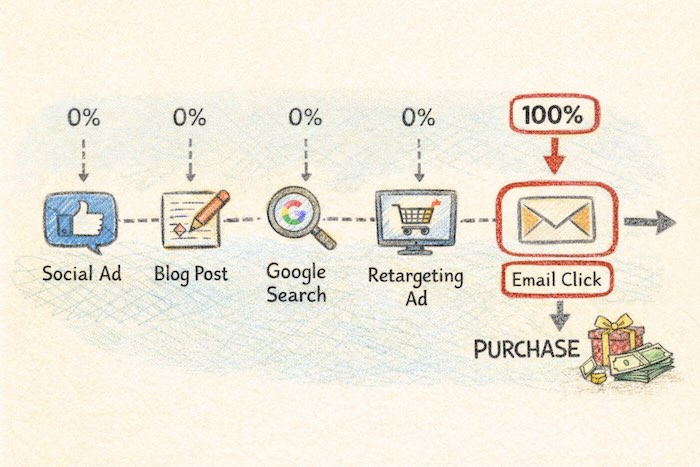
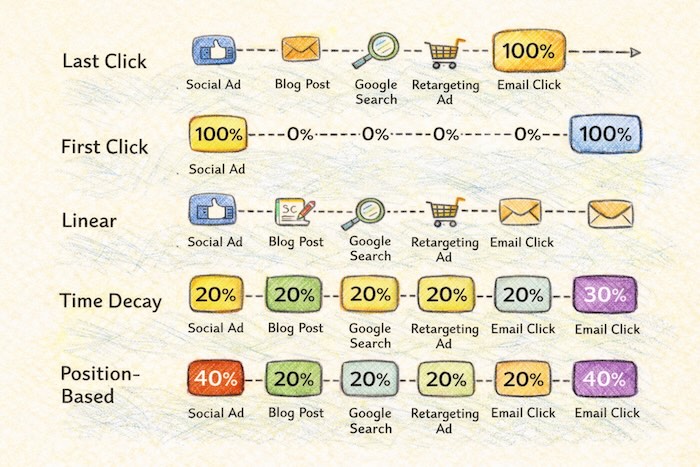
Last click attribution is a measurement model that gives 100% of the credit for a conversion to the final touchpoint before someone converts. If a customer clicks five different ads over two weeks but makes a purchase right after clicking your email link, the email gets all the credit. Everything else gets zero.
This model became popular because it’s simple. You don’t need complex tracking or statistical models. One conversion, one source, done. For years, it was the default in Google Analytics and most advertising platforms.
However, simplicity comes at a cost. The customer journey rarely works like a single click leading to a purchase. In reality, people discover your brand through one channel, research through another, and convert through a third. Last click attribution ignores this complexity entirely.
The Real Problem: How Last Click Misleads Your Budget Decisions
Let me show you a real scenario. Imagine you spend $10,000 per month across four channels:
- Content marketing (SEO blog posts): $3,000
- Paid social ads: $3,000
- Email marketing: $2,000
- Retargeting ads: $2,000
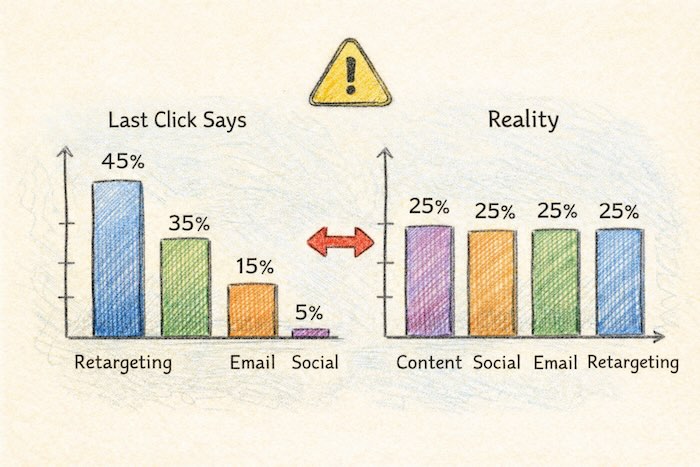
Your last click report shows that retargeting drives 45% of conversions, email drives 35%, paid social drives 15%, and content marketing drives only 5%. Based on this data, you might conclude that content marketing is a waste of money.
But here’s what’s actually happening: your blog posts introduce people to your brand. They come back through social ads. They sign up for your email list. Finally, they click a retargeting ad or email link and buy. Without the blog posts, those people would never enter your funnel in the first place.
Research from Unifida found that last click attribution can overvalue PPC by 22% while undervaluing other channels by significant margins. In one retail case study, this translated to over £1 million in misattributed value.
The Domino Effect of Bad Attribution
When you cut budget from “underperforming” channels based on last click data, something interesting happens. At first, nothing changes. Your retargeting and email campaigns keep converting. Therefore, you feel validated in your decision.
Then, weeks later, conversions start dropping. Why? Because you’ve starved the top of your funnel. Fewer new people are discovering your brand. As a result, your retargeting audiences shrink. Your email list stops growing. The channels that looked like heroes were actually just catching people that other channels had already warmed up.
A travel industry test documented by Crimtan demonstrated this perfectly. When they turned off channels that last click said were driving sales, overall sales actually went up that month. The “high-performing” channels weren’t driving sales at all — they were just taking credit for them.
When Last Click Attribution Actually Works
Despite its problems, last click attribution isn’t always wrong. In certain situations, it can be a reasonable model to use.
Short sales cycles: If people typically buy within one session or one day of discovering you, the last click is often the only click. For impulse purchases under $50, last click may capture reality accurately enough.
Single-channel businesses: If you only run one marketing channel, attribution doesn’t matter. There’s nothing to compare.
Direct response campaigns: For campaigns specifically designed to convert warm audiences immediately, last click measures exactly what you care about — the final push that closed the deal.
Limited analytics resources: If you don’t have the tools or expertise for multi-touch attribution, last click is better than no attribution. Just understand its limitations.
As noted by Supermetrics, last click attribution may actually be more reliable in 2025 than some complex multi-touch models, because it doesn’t require the granular user tracking that privacy changes have made difficult. If your organization is navigating these privacy requirements, our step-by-step GDPR-compliant analytics setup guide covers what you need to get right.
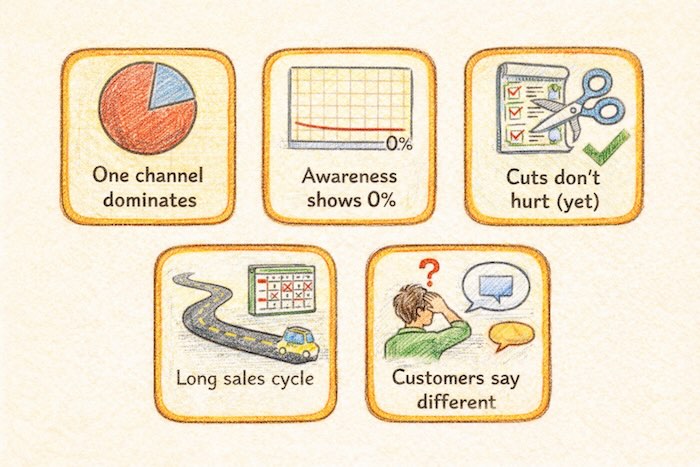
Five Signs Your Attribution Is Lying to You
How do you know if last click attribution is misleading your marketing decisions? Look for these warning signs:
1. One channel dominates conversion credit. If a single channel (especially retargeting, branded search, or email) shows 50%+ of conversions, last click is probably distorting your view. These channels typically catch people at the end of their journey, not the beginning.
2. “Awareness” channels show almost no conversions. Content marketing, display ads, podcasts, and organic social rarely get last clicks. If these channels show near-zero conversions in your reports, it doesn’t mean they’re not working. It means last click can’t see their contribution.
3. Cutting a channel doesn’t immediately hurt results. This is the trap. When you reduce budget on an upper-funnel channel and conversions stay stable for a few weeks, last click says you made the right call. But wait two months and watch what happens to your pipeline.
4. Your sales cycle is longer than a few days. For B2B companies or considered purchases, customers interact with your brand many times over weeks or months. Last click ignores all that history.
5. You can’t explain how customers find you. If your reports say email drives most sales, but customers tell you they found you through a podcast or blog post, believe the customers. Your attribution model is missing the real story.
What to Use Instead: Practical Alternatives
If last click attribution is problematic, what should you use instead? Here are practical alternatives, ordered from simplest to most sophisticated.
First Click Attribution
First click attribution gives all credit to the first touchpoint that introduced someone to your brand. It’s the opposite of last click — equally simple, but biased toward awareness channels instead of conversion channels.
Best for: Understanding which channels fill the top of your funnel.
Linear Attribution
Linear attribution splits credit equally across all touchpoints. If a customer had five interactions before converting, each gets 20% credit.
Best for: Getting a more balanced view when you’re not sure which touchpoints matter most.
Time Decay Attribution
Time decay gives more credit to touchpoints closer to the conversion. The first touch might get 10%, while the last touch gets 40%. Interactions in between get graduated amounts.
Best for: Businesses where recent interactions genuinely matter more than early ones.
Position-Based (U-Shaped) Attribution
Position-based models give 40% credit to the first touch, 40% to the last touch, and split the remaining 20% among middle interactions. This recognizes that the introduction and the close both matter.
Best for: Most B2B and considered-purchase businesses where both discovery and final conversion are critical moments.
Data-Driven Attribution
Data-driven attribution uses machine learning to analyze your actual conversion data and assign credit based on statistical patterns. Google Ads now uses this as the default instead of last click. If you’re considering platforms beyond Google for attribution, our overview of analytics tools that don’t rely on cookies covers several options with built-in multi-touch capabilities.
Best for: Businesses with enough conversion volume to train the algorithm (typically 300+ conversions per month).
How to Transition Away From Last Click
If you’re currently relying on last click attribution, here’s a practical path to better measurement.
Step 1: Run models in parallel. Don’t switch cold. Run your current last click reports alongside a linear or position-based model for 2-3 months. Compare what each model tells you about your channels. Make sure your UTM parameters are consistent so you can trust the source data.
Step 2: Look for discrepancies. Which channels look dramatically different between models? These are the areas where last click was likely misleading you. Focus your investigation there.
Step 3: Talk to customers. Survey recent buyers about how they discovered you. Compare their answers to what your attribution says. Customer feedback is often more accurate than any model.
Step 4: Test with holdouts. The ultimate test is to turn off a channel that last click says is underperforming and see what happens over 60-90 days. If conversions drop significantly, that channel was doing more than last click showed.
Step 5: Convince stakeholders with data. Show leadership the parallel model comparison. Demonstrate specific cases where last click told a different story than reality. Use the retail case study numbers: potentially 22% misattribution means real money on the table.
For a deeper understanding of how analytics connects to business decisions, see our guide on what analytics in digital marketing actually means.
The Bottom Line
Last click attribution is like judging a relay race by only watching who crosses the finish line. You’ll know who finished, but you’ll have no idea what actually won the race.
For simple, single-channel, impulse-purchase businesses, last click might be good enough. For everyone else, it’s a model that systematically undervalues the channels that build your brand and fill your funnel, while overvaluing the channels that simply catch people at the moment of conversion.
The good news is that you don’t need perfect attribution to make better decisions. Simply understanding that last click has these biases — and cross-checking it against other models or customer feedback — will help you avoid the worst budget mistakes.
Start by running one alternative model alongside your current reports. Look at the differences. Ask customers how they found you. In most cases, the real picture is more balanced than last click suggests.